Playful exercise
A virtual companion turns repeated arm movement into a care task.
04 / Project
Mixed-reality rehabilitation concept
Explores how playful MR interaction, sensor feedback, and a companion app could support engagement during at-home rotator cuff recovery.
01 / Challenge
Home rehabilitation is repetitive, difficult to track, and easy to abandon.
The team explored how playful interaction might support engagement during at-home rotator cuff recovery. The focus was motivation and adherence—not diagnosis, clinical validation, or measuring recovery outcomes.
02 / Scope
Early research covered multiple surgery types, pain management, sleep, accountability, AI coaching, and remote therapy. Mentor feedback revealed that the system was becoming unclear. The team narrowed the work to active recovery, one repeatable upper-limb movement, and an MR interaction supported by a companion app.
03 / My contribution
I supported the team by reviewing information used in the final presentation, correcting inaccurate pitch-deck data, and prototyping an audio-feedback system for movement outcomes. I also participated in brainstorming, technical discussion, and limited prototype development.
04 / Audio prototype
The Unity prototype contains two audio banks: praise after a successful target action and supportive encouragement after a non-target collision. The logic randomly selects from each bank, controls playback volume, and prevents clips from triggering too rapidly.
05 / Team system
A virtual companion turns repeated arm movement into a care task.
An Arduino-based prototype explores sending physical input to Unity.
Goals, schedules, progress, and therapist communication extend beyond the headset.
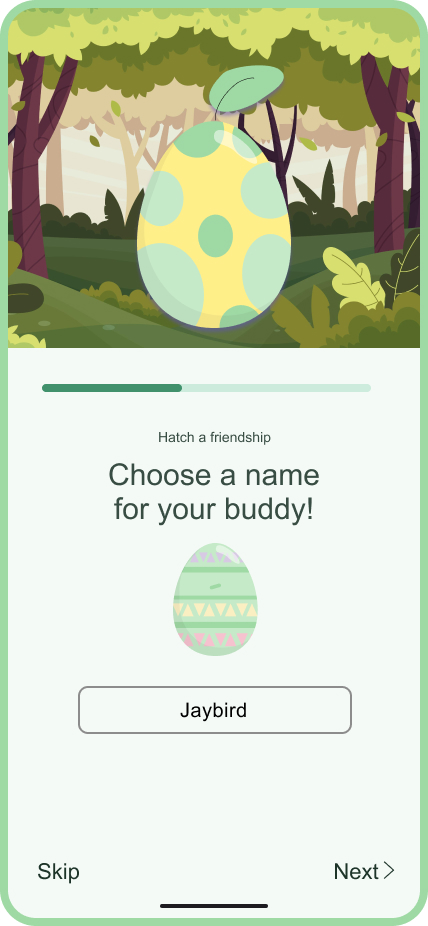
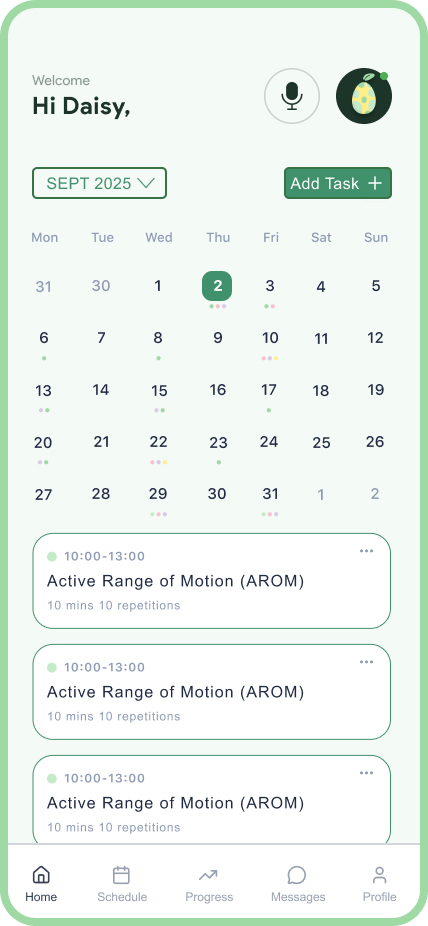
Companion-app visuals are shown as team outcomes, not individual design ownership.
06 / Outcome
In 48 hours, the interdisciplinary team produced a working Quest APK, an MR exercise demo, a sensor-to-Unity prototype, a high-fidelity companion app, a pitch deck, and system documentation.
07 / Reflection
This was my first hackathon after entering graduate school. The strongest lesson was not how to add more technology, but how to reduce an ambitious idea into one experience that a team could build and demonstrate in 48 hours.