Clarify once
Ask one question only when the input contains multiple possible intents.
02 / Project
Course-recording retrieval tool
Turns a vague memory of a technical lesson into a verified, timecoded lecture moment.
01 / Problem
A 20-second answer can be buried inside hours of recorded instruction.
Students in software-heavy courses often remember that an instructor demonstrated a step, but not the lecture, wording, or timestamp. Recovering that one moment can mean scanning multiple recordings and interrupting the assignment already in progress.
The information exists. The problem is the cost of retrieving it.
02 / Insight
A recording archive is organized by weeks, titles, full videos, transcripts, and timestamps. A student remembers a question: “Where did the instructor explain how to update nested state?” CuePoint starts from that natural memory and translates it into a retrievable intent.
A timestamp is not enough. Users need evidence before they act.
03 / Scope
Search using the task or problem the student can remember.
Show why a result matches before sending the user into the recording.
No live transcript pipeline, production backend, or live API.
04 / Solution
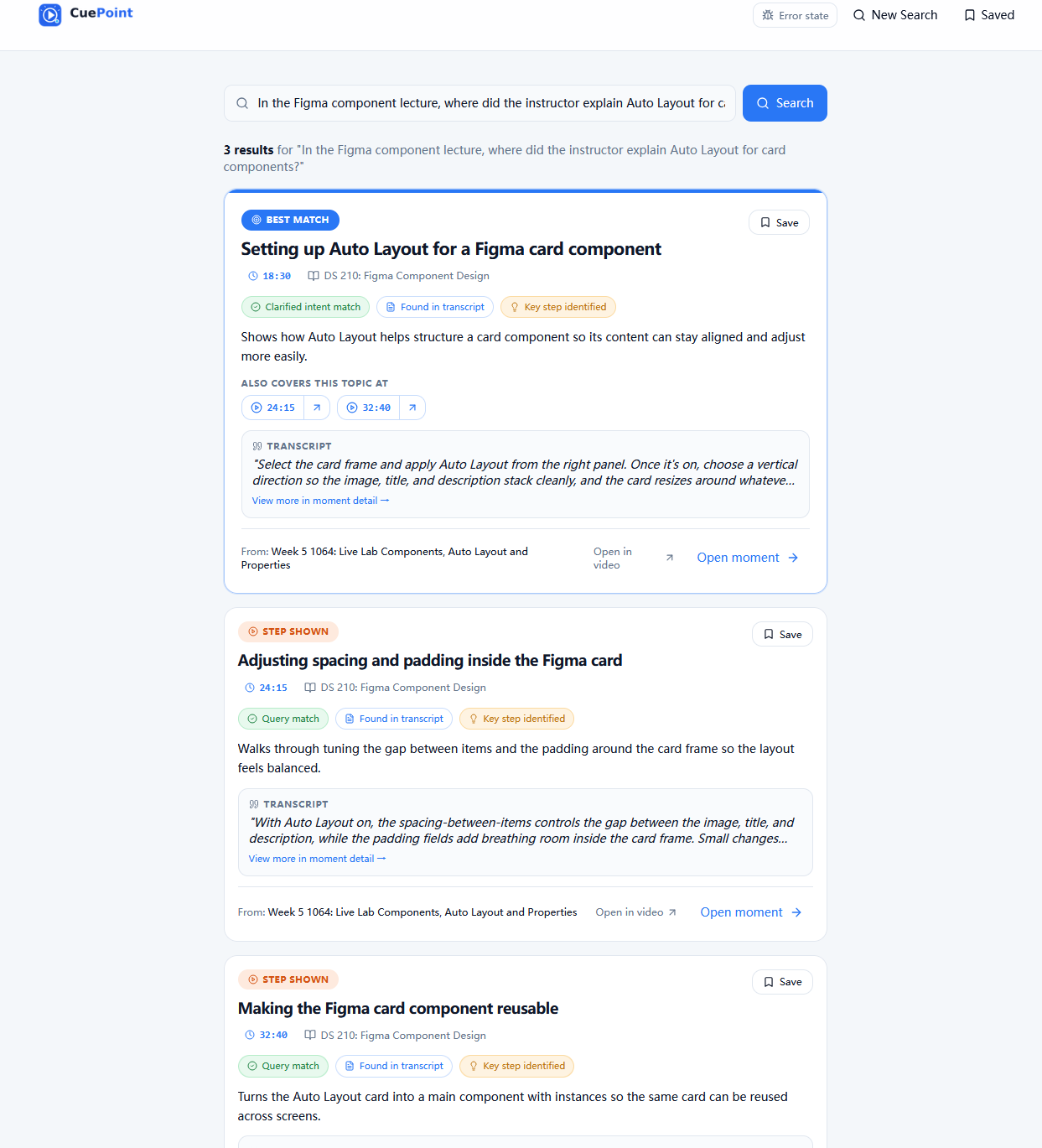
Best Match makes the recommendation legible before the user watches.
05 / Key decisions
Ask one question only when the input contains multiple possible intents.
Skip clarification when enough context already exists.
Refuse to force a plausible-looking answer outside the curated course data.
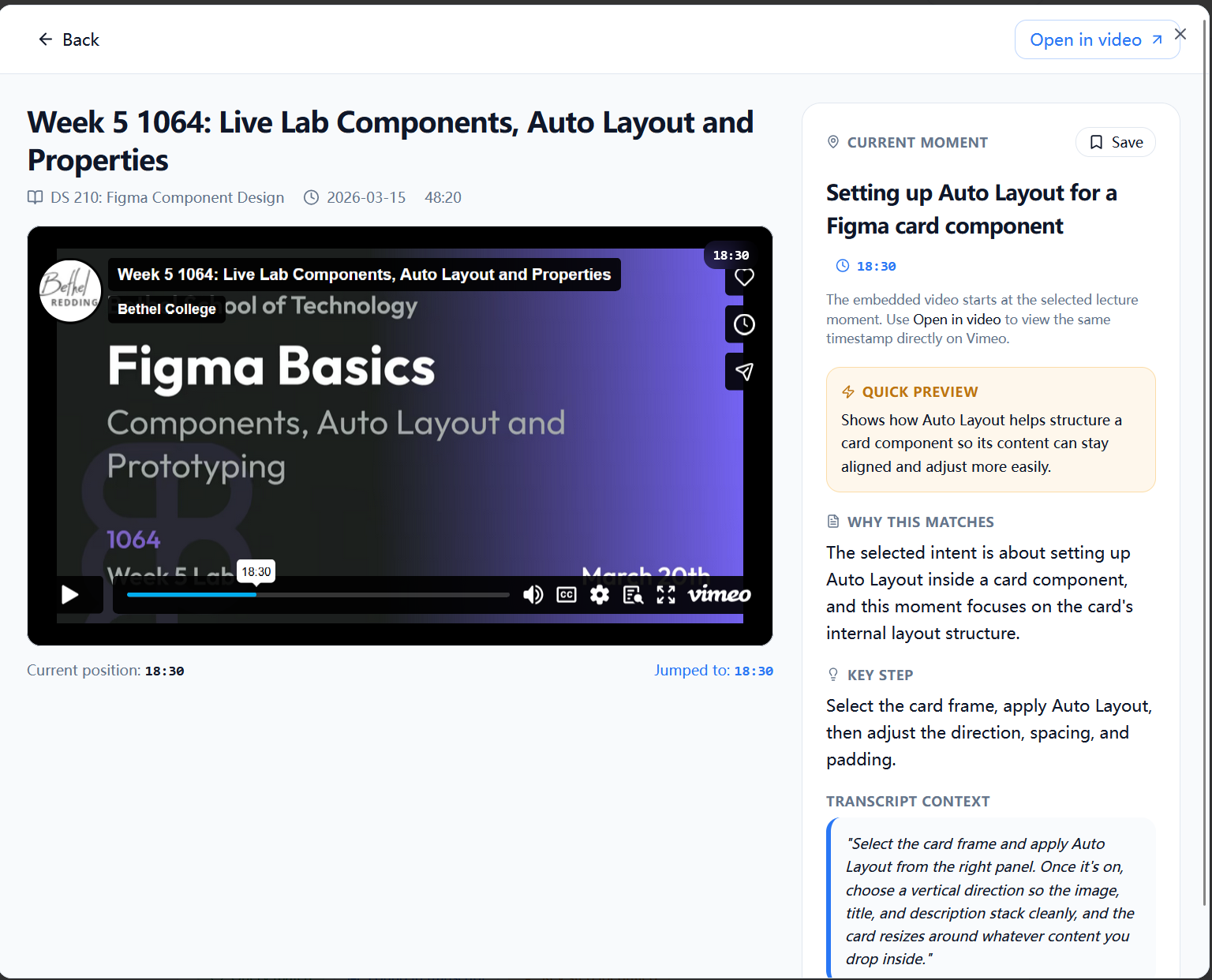
Moment Detail is the confirmation layer between a result and the original recording.
06 / System
The final model connects six entities. The segment is the key bridge: it turns a long recording into a retrievable instructional moment while preserving its course and video context.
07 / Testing
Tested whether the search structure, result hierarchy, and core navigation made sense.
Tested conditional clarification, more judgeable results, richer Moment Detail evidence, clear system feedback, and no-match handling.
08 / Outcome
I owned problem framing, scope definition, system logic, information architecture, interaction design, the data model, prototyping, testing, iteration, and final product communication.
The MVP proves the end-to-end interaction from natural question to verified lecture moment. Live ingestion, real-time transcripts, and production matching remain future technical work.